
September 2026 — In a lengthy Interview with the NY Times, Canada’s Prime Minister’s reveals his thinking, planning, opinions and much more… Here we see an exceptional exploration of how today’s shifting geopolitical world is being navigated within international turmoil and a horizon of threatening times
Strategic Demands: A extraordinary interview and timestamp documenting geopolitical realities faced by the Canadian Prime Minister. Here, we see the navigation skills required and demonstrated by an exceptionally trained and talented man who guides his ship of state through shifting winds… At StratDem we speak of the need for “Strategic Realism” in international relations, of security competition and values-based politics in foreign policy. Canada is fortunate, in our opinion, to have such a person at the helm of its representative democratic governance.
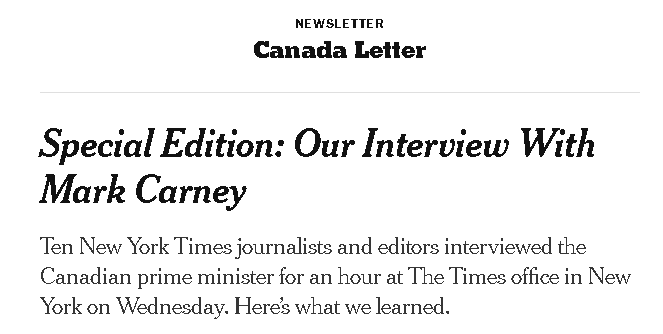
TRANSCRIPT
(Public domain/Unlocked/Shareable)
September 27, 2026
New York Times
(Interview conducted by Joseph Kahn, the executive editor; Kathleen Kingsbury, the opinion editor; Philip Pan, the international editor; Matina Stevis-Gridneff, the Canada bureau chief; Ezra Klein, an Opinion columnist and podcast host; Natalie Kitroeff, a host of “The Daily” podcast; David E. Sanger, a White House correspondent with expertise in national security and diplomacy; Tyler Pager, a White House reporter; Colby Smith, an economics reporter who covers the Federal Reserve; and Sydney Ember, an economics reporter.)
Trade with the United States
Joseph Kahn
We just saw the actual text of the agreement with Greenland between the United States and Greenland. It looks a good deal like the security agreement that the United States had with Greenland right after World War II, and doesn’t appear to come very close to matching the rhetoric that President Trump attached to the whole effort. And it makes me wonder a bit, because so much of the battle, such as it is between the United States and Canada, seems to rely on the rhetoric coming from Trump. Do you imagine that something similar could come out of this heightened conflict between the two at the moment, or do you think it’s deeper, more serious than that, and actually will have some kind of permanent impact in relations?
Mark Carney
I wouldn’t mind not using Greenland as the analogue here, although I will concede that there are elements of the discussions, negotiations and the relationship over the last 18 months which have looked to impinge on Canadian sovereignty. The Greenland issue is obviously a series of sovereignty issues. There’s a history there, with which you are well familiar. Go through the fine-tooth comb of the agreement, and judge what actually changed and what was reaffirmed.
With respect to our discussions with the U.S. — have things changed? Yes, things have changed. There have been direct threats to our sovereignty, rhetorical, but efforts in negotiations that would have impinged on our economic sovereignty, which we would not accept.
Aspects that were termed as “irritants” by the U.S., which are fundamental rights in Canada — language rights, cultural rights — which were worked into a proposed agreement, and that was enough of a red line in and of themselves not to sign. Restrictions or potential restrictions on our ability to sign trade deals with other countries. You know Canada is, by our judgment, the most connected economy in the world. We have free trade agreements with 1.5 billion people. We expect that’ll be three billion by the end of this year. Maybe it’ll slip by a couple months, but we will get to that three billion number, so we don’t want our hands tied. We don’t want to ask permission to have trade deals with other economies, or we would like it reciprocal, which I don’t think would happen.
So those elements are still rhetorical, because they haven’t come into force, but there was more substance behind elements of the rhetoric. The other thing that’s changed, and it’s a judgment how long it endures, is that it’s the avowed policy of the U.S. government for all countries, to charge access to the U.S. market.
In some cases, that’s tariffs. It’s normally a combination of tariffs, investment commitments, changes to domestic policies as part of broad trade agreement requirements, and, as you move along that spectrum, you move into issues of sovereignty. So, from our perspective, we look at it in several ways.
The basic is there is a mutually advantageous trade deal to be had that can be built above and beyond, and we’ll negotiate in good faith for that, and we will sign that. Even though in some areas, it will be different from the trade agreement that we do have with the United States.
We do have a trade agreement with the United States, called U.S.M.C.A. It’s still in force. Congress hasn’t repealed it, and the U.S. has violated it. Those are the facts. But in a realpolitik way, there is something that can be negotiated, given the change in the U.S. stance commercially.
We do have very clear red lines, as you would expect, in terms of sovereignty, and the dynamics of this mean that those are more likely to be respected if and when there is an agreement.
But the other big lesson we take is twofold. One is we’ve got to build up our strength at home, and that’s what we’ve been doing. We’ll have a chance, maybe, to talk about that. And we have to diversify our partnerships abroad. And in diversifying those partnerships abroad, we are focusing particularly on strategic capabilities. In areas where our sovereignty can be impinged by any of the hegemons, in effect — critical minerals is a classic example for the U.S., what China attempted to do. Defense infrastructure is another example. Financial payments is an example. We have joined in sanctions on Russia, so we’re very conscious of where others could have leverage over us, and we’re looking to diversify in ways that reduce that leverage and obviously create commercial advantage. And once you see that, what we’re doing with others is pretty predictable.
Relationship with China
Kathleen Kingsbury
Before your election, you identified China as one of the biggest threats to Canada. I’m curious if you still see the relationship that way, if other things have taken over that at this point, or how you generally view your partnership with China or alliance with China.
Mark Carney
Two things can be true at the same time. There’s certainly issues. We’ve had issues with China, and the relationship reflected those issues. We’re very vigilant about foreign interference from any actor in our society, but we’re also calibrating our relationships according to our values, is ultimately the way we frame it.
Our commercial relationship, our people-to-people relationship, our cultural relationship with China, when I became prime minister, was fundamentally broken. Canada was in a bucket with most failed states in terms of visa restrictions and so on. I had a few conversations with President Xi about this and setting up clear guidelines on the relationship, where we look to cooperate, where we did not expect to cooperate. So when we say we calibrate the relationship, we’re not going to have deep cooperation with China on A.I., for example. Defense, we are not going to cooperate on.
Kathleen Kingsbury
Would you have China build infrastructure in Canada?
Mark Carney
They built some infrastructure in Canada. Where we’ve identified was on the agricultural side. We struck a deal with China in January, which received a lot of attention, which is a fraction of the level of U.S. cooperation with China. We struck a deal which reopened Chinese markets for Canadian agriculture and some fishing goods, which allowed China to export to us at a capped level the amount of cars that they exported in 2024 — 49,000, less than 3 percent of our market. They were all Teslas in 2024. We might get a bit of a mix.
There’s a few other things in that group, but that’s basically it, and it’s the start of a process. We think with China, there’s energy cooperation, both clean and conventional. They need some conventional. Their expertise around clean is unquestioned, and so there’s cooperation there. There are a few other areas, but one I’ll just put on the table — we are of the view, like the United States, that there is a serious imbalance issue globally. Part of it is a financial sector issue. Part of it is the emergence of the Chinese financial sector and the ultimate flexibility of the renminbi. That is a very challenging process. It’s very easy to get that wrong. We have some expertise in that, and so part of it will be financial services cooperation.
Currency and global finance
Colby Smith
How much of the thinking around the renminbi, though, is something that you spent a lot of time thinking about when you were governor of the Bank of England — dollar dominance and the instability of that system? How does that fit into your ambitions today? And when you think about what you’re prioritizing, is there more momentum, perhaps, for this shift away from the dollar than we’ve seen in quite some time?
Mark Carney
There is. This isn’t a sentiment. It’s a reality. You see it in a variety of metrics from reserve composition, payment flows, other aspects. It’s sometimes represented that the shift in stablecoins and other things will arrest that. In the end, you’re swapping payments through a different system than a bank-based system so, in general equilibrium, it doesn’t materially change it. There is a shift. There’s a directional shift. That shift can’t fully happen until there’s proper liberalization in China. That’s the tough thing to do for them, for anybody to go from their system to have capital liberalization. So that will limit the extent to which it happens.
Would the global system be in a better position if we had — I’ve long thought this — diversification of reserve currencies? The answer is yes. That would provide more flexibility. If I were the reserve currency, I would want to keep that position for as long as possible, and so I understand the U.S. position there. But, the U.S. wants a weaker dollar, imbalances adjustment and to retain full reserve currency. And ultimately, our view may be wrong about this, but history tells you and logic tells you that rebalancing — yes, it’s partly structural policy in China — but it’s also going to be monetary reform, and that is going to shift reserve currency composition.
Want to stay updated on what’s happening in Canada and India? Sign up for Your Places: Global Update, and we’ll send our latest coverage to your inbox.
Colby Smith
How much of that, though, do you think is a reflection of U.S. administration actions and cutting off trade? Is that a direct result of that, or is that just where we were headed anyway?
Mark Carney
One of the costs, and we are a participant, Canada’s a participant in this, and given the stakes in Ukraine, it’s the right thing to do, it was before I was in government. But the freezing of Russian reserve assets and using the SWIFT payment system. The lesson that reserve holders and others take from that is you need to diversify into different payment systems. You can’t hold, if you want to really have the reserves and use them, you can’t hold them in certain banks, you can’t hold them in certain areas. And the reality is that, as you know, you can sanction U.S. persons, and U.S. persons are anything that touches the dollar, and up until recently, virtually every financial transaction ultimately touches the dollar.
Even if you’re in two different currencies, the base currency is the dollar. That is now changing, and that is a big deal. It takes a while for it to happen, but it’s a big deal. One of the questions to go back to, if I can generalize your first question — there’s certain things, once you’ve seen them you can’t unsee them.
And when integration is used as leverage for coercion, it’s the “fool me once, fool me twice” point. You know, “shame on you, shame on me.” And once you see that, then you start to think, OK, how do I diversify away? And so part of what’s happening, and it’s a big lift, but directionally the forces will point in the same direction. We’re seeing it on the finance side.
Interdependency and Starlink
Ezra Klein
Let me ask you about how you generalize that point. So, one tension I hear in what you’re saying at the beginning, you say Canada is arguably the most open economy in the world, the most trade agreements, more coming.
Mark Carney
Yes.
Ezra Klein
And also something I’m hearing you say, something that’s become more prevalent here, is a sense that free trade, these open agreements, create interdependency, and interdependency in this era is dangerous. How do you think, at a principles level, about the case for openness versus the dangers of openness and interdependence?
Mark Carney
That is the fundamental tension, and so the way we think about it is: What are the areas that have the most leverage, and which we call strategic capabilities. So energy, food and fuel — you get a lot of leverage, and we’re pretty well positioned for that in action. Critical minerals, obvious. The tech stack, and should you slice the tech stack, but the tech stack: space, basically because defense in space and satellite within space is very quickly linked.
If you’re us, where do you have strategic capabilities? Where do you have leverage? And then how do you use those to build out where you’re short? Who do you partner with to help build out where you’re short? And for us, our point of departure, our answer to that, is we’re not going to be able to be a target. That’s not the right way to go. But we’ve got to be smart about who we partner with and where we go deep in those areas. So we’re not going to want to go deep with China in the defense aspect.
We’re much more interested in going deep with many European countries in defense because it’s complementary, because they’re not going to use the leverage against us. And second order, but super important, is it tends to be the case with those deals, and what we’re seeing, is we get a much bigger percentage of the value add in Canada, so more jobs and industrial benefits. There’s no perfect, but the more options you have, a dense web of connections, the more you build that out, the more robust you’re going to be. And we start quite exposed to the United States. You’ve got to net out some of the cross trade and identify the areas where we think we can rely on the U.S., whatever the political weather. And where we would be wise to have other options.
Ezra Klein
How do you balance tech dependencies given things like compute and Starlink?
Mark Carney
Starlink we will diversify away from, no question. Telesat LEO constellation, [will be launched in] Q1 2028, and that is an example where, at not the same scale as Starlink, but from a defense perspective — and certainly pooled with other partners, Europeans, Koreans potentially — you get to scale, and you cut that dependency, which has in certain circumstances been turned on and off in a way that was not sovereign to the actors in the conflict. And so again, that’s something you can’t unsee, and so it drives it on that. That’s on the space element.
The broader tech, exceptionally difficult. Nvidia chips, there are only so many chip makers. Enterprise A.I. solutions, sovereign cloud can help you get a step of the way there. It’s still to play for. It’s more to play for, and it’s clearer six months on than it was six months ago, just in terms of do you need to be at the frontier.
And look, I don’t want to leave the impression that our entire strategy is diversifying away from the U.S. But what we’re aware of is, if we are not more diversified, if we don’t have broader and deeper partners elsewhere, we can be held up, and we don’t want to be in that position.
And the way we look at what we’re doing right now is it’s a robust strategy, because if the U.S. goes back towards the previous trajectory and its view of openness and its view of the relationship with Canada, etc., then we’re going to be a better partner with these other partnerships. If it doesn’t, if it stays on the current trajectory, we will have had to have done this. So we had the motivation to do it, and what I find, if you have access to everybody around the world, is that more and more countries are thinking in the same terms. So the conversations are, and what’s falling on from it are quite tangible.
Energy exports and potash
Matina Stevis-Gridneff
Are there any circumstances under which you would consider curbing, limiting or imposing additional taxes on exports of energy products or potash, in view particularly of the most recent announcement by President Trump regarding Belarusian potash, which I believe is sanctioned and quite far away?
Mark Carney
Well, we view Belarus as a party to Russia’s illegal war, for a variety of obvious reasons, including where the troops came from and the support. Our position is, and I’m going to quote the head of the I.E.A. [International Energy Agency]. He said it again yesterday, Fatih Birol, that the most important commodity in the world is trust. When he came to Canada, I don’t know if he said it yesterday, but he said it publicly a couple times a few months ago in Canada: “this is what you have. This is your most important part: You’re a reliable partner.” If you’re a reliable partner and you supply energy or food to somebody, it keeps flowing. It’s a very, very, very high threshold to change that. We honor our trade deals, and, yes, we’ve taken some retaliatory measures or counter tariffs against the U.S. because of what they’ve done, different orders of magnitude, and in most cases to protect the industries that got a tariff, goods are flowing back into Canada, so it is a very high threshold.
Never say never, but it starts from a position of: we need to be a reliable supplier in all cases, particularly if we’re going to continue to be open.
Defense cooperation and procurement
David E. Sanger
There’s a tension between how you supply, particularly your defense stack here, and your reliance on the U.S. for things for which you cannot have anybody else step in. NORAD [the North American Aerospace Defense Command] is the most integrated defense system I’ve ever seen. You never know whether it’s an American or a Canadian plane that is going off to intercept the Russians or something along the way. The nuclear deterrent, you’re not going to replace with the Europeans and so forth. So, as you think about what’s permanent in this, it sounds like the diversification is permanent because you never know which way the U.S. is going to go. But this other core of it, which is your fundamental defense, it doesn’t seem to me you have a plan to diversify from it.
Mark Carney
A protected Canadian Arctic is first and foremost our responsibility, but it’s clearly in the U.S. interests as well. Our approach there has been to take more and more responsibility for our own defense. So I came in, yes, people in NATO were all moving in these directions, but we were 1.4 percent of G.D.P., two and a quarter last year. We have provisioned all the way to 4 percent by the end of this decade. So it’s in the budget. Exactly what we’re going to spend it on, we’re in the process of determining it, not least because technology is changing pretty rapidly. So if you take the list from the generals that they had a year ago, a lot of it is going to be outmoded. It’s not going to be the best spend. Secondly, we intend to get maximum value for those dollars, and part of it is through defense partnerships. So, for example, our submarine deal with the Germans and the Norwegians, about 40 percent of the value add will be in Canada — $40 billion, big orders of magnitude. A big component of what we’re doing on defense is Arctic security. So, four new bases in the Arctic, the submarines, some of the aircraft decision we have to make is how well they work in the Arctic. We are spending a lot more time with our Nordic partners, the Germans, and the French, because they are more active in the Arctic and it’s much more integrated. So, under the umbrella of NATO, us plus the Nordics plus the Germans, and then down into the Baltics, that is much more integrated, and will increasingly become more and more integrated. The U.S. of course, primus inter pares in NATO, but they’re not part of that. They’re party to it, not part of it. And that’s part of taking more responsibility. But hypersonic missile defense coordination with the United States will still be…
David E. Sanger
And Five Eyes?
Mark Carney
Yes, and Five Eyes.
David E. Sanger
You don’t see them suffering from what you’ve been going through?
Mark Carney
It hasn’t been the case.
Matina Stevis-Gridneff
I heard the beginning of an argument there in favor of more Gripens and fewer F-35s forming. Is that where your headed?
Mark Carney
I wouldn’t say it’s where we’re headed. It is a real decision. It is a real decision because of differing capabilities, because of strategic dependencies, and because of the economic return.
Threat of U.S. military force against Canada
Natalie Kitroeff
At any point in the last 18 months, were you ever seriously concerned that President Trump, as these threats escalated, would seriously use military force against Canada?
Mark Carney
[Pauses] You have a responsibility in these roles to look at extreme tail risk. So, and as the tail fattens when a leader of a country threatens your sovereignty, you adjust accordingly. That’s just risk management. That’s not a base case, but it would be irresponsible not to take certain things into consideration.
David E. Sanger
Did you make certain preparations for that?
Mark Carney
I’ll leave my answer where it was.
Immigration
Kathleen Kingsbury
Can I ask you a domestic question? You know, I believe earlier this year you blamed some of the economic challenges that Canada is currently facing on population decline.
Mark Carney
It’s a factual observation, but if your labor, your population is shrinking, your labor force is shrinking, then it’s a per capita versus an overall level. It’s not blaming, it’s observing. It’s not blaming.
Kathleen Kingsbury
One element of that decline has been from the immigration cuts by your government, and I’m curious when you’re planning on reversing those.
Mark Carney
I’m going to simplify, but what happened post-Covid is there’s a series of ways you can come into Canada.
One is through controlled immigration, point systems, picture of economic and family reunification that had been gradually increased — think 300,000 people here.
You have asylum seekers, which obviously you don’t control people show up somehow and they seek asylum. And then we have rights-based processes that work that way. That can fluctuate depending on the situation, largely coming from the U.S. and then the other components that were uncapped and demand driven were foreign students and temporary foreign workers.
So, under certain criteria, postsecondary institutions could grant visas or get visas for foreign students and temporary foreign workers. And there was a surge in demand through those two channels. The consequence of that was an immigrant population that went from 3 percent to 7.5 percent of the population in a little under five years. So it’s a huge shift. Now, we’re a country of immigrants. We consistently take around 1 percent of our population in terms of immigration. So the consequence of that was that the pressure on the education system, the pressure on housing, the pressure on other things was very high. So we stopped those from being purely demand-driven and capped them. And the fact was that what was also happening on the postsecondary side was there were basically degree factories coming up that were there for the visa as opposed to some of that demand.
Kathleen Kingsbury
Was some of that demand because of policies from the Trump administration and students who are coming to Canada?
Mark Carney
No, President Trump came in second term, and we made these changes within a few months, so it wasn’t being driven because of that.
What we’ve basically been doing is first getting the system under control. So if we want to let in 500,000 people through formal immigration and some temporary workers and students, we cap things and we let in 500,000 people. There were years where the expectation would have been for example, 700,000 and it ended up 2 million. The overshoots were, and you know it’s a country of 40 million people.
These are big, big overshoots, and it’s not that easy to get to Canada, right? It is from the U.S. but otherwise you’re flying in or taking boats. So we’ve taken measures to get that under control and we have it under control. So students down by 60 percent, temporary foreign workers down by 50 percent. It happens to be the case. Part of this is tightening, but asylum seekers are down by one-third on a flow basis, and now the question starts to become: When do we resume some controlled increase in the population, which is the nature of Canada. So that will happen, and we just want to make sure that we’ve got it under control.
Outreach to the European Union
Joseph Kahn
Can I give you a skeptical view about your negotiations with the European Union over associate membership, and just looking at what a tighter affiliation with Europe has to offer. You already largely have open trade with them. You largely have open visa access. I guess there can be some improvements, but you have essentially zero growth in Europe. Very low growth. You have chronic high deficits everywhere, and they’re not really at the bleeding edge of development of any new technologies, especially A.I., and the potential for candidates to significantly benefit from a tighter relationship with the European Union, as its relationship with the United States sours, in that sense, is limited. I’m putting up a straw man a little bit. But realistically, does Canada have a huge amount to gain from a tighter affiliation with the E.U., or do you ultimately, at the end of the day, need to try to work out a stable relationship with the United States?
Mark Carney
Well, the answer is both. Both, and.
Our trade deal with India is important to us, and U.S., yes, Europe, India, ASEAN [the Association of Southeast Asian Nations] and beyond. But in terms of your core question, the European opportunity, I’d say a couple things. One is, it’s the second biggest economy in the world. It’s not growing, but it’s the second biggest economy in the world, in hard dollars, hard euros, and we are underpenetrated in that economy, and there’s some reasons why we’re underpenetrated in that economy. And in fact, when we look at what our capabilities are, sorry, I’m going to talk like an economist. But if you look at revealed comparative advantage in Canada, where we can grow our economy and grow our exports, it is our biggest opportunity. Greater penetration of Europe is a bigger opportunity for Canada than China is. China is a bigger economy. Yes, we can do some agriculture stuff. We can do some energy stuff, and we will do that, and a few other things.
But China is less complementary to the nature of our economy than Europe right now. So that’s the second point. Third point, to go back to the earlier discussions, there’s a few key areas where we can get strategic autonomy with Europe. Space is one of them. Space satellite is one of them. A series of things on the defense side. We’re going to spend half a trillion dollars on defense in the next 10 years, and it’s a huge number for Canada. We want to get the maximum benefit of that. We will not get the maximum benefit from that with other jurisdictions. In order to get the maximum benefit for that with Europe, we’re going to not just be part of SAFE, which is their defense procurement, but we’re going to have to have similar approaches on cyber, on A.I., on space and others, so the synergies there are quite significant as well.
The Europeans are not — I know you’re doing a straw person — but you know, they’re pretty cutting edge on pharma. We’re pretty good in pharma. There’s an opportunity there. So, our pooling on research as part of Horizon is a real advantage. Pooling on universities, you know, we would look to be part of Erasmus, which basically means Canadian students go there, their students come here, that sort of people-to-people ties.
Here’s one thing that we offer them apart from critical minerals and energy and serious things there, which actually the energy side is reciprocal because some of the expertise, non-China expertise in clean energy, a lot of it’s European.
Eighty percent of European data to Asia goes through the Red Sea, cables in the Red Sea. The quickest two points from Europe to Asia go through Russia. Good luck. Or you can go across Canada. Strategic capability, independence, Canada, Europe, we win because we’re going to build that out. There’s more. There’s a lot to this. That’s yes, economic, and actually cultural. And I wouldn’t downplay — not that you did — the cultural side of it, cultural sovereignty, cultural independence. We’re not going to be threatened. The Europeans aren’t going to tell us what we have to put on our landing pages of Netflix or Spotify or whatever, and that stuff matters.
Relations with India
Matina Stevis-Gridneff
You mentioned India and it’s timely. [Prime Minister Narendra] Modi is coming to Canada. You visited earlier this year. Obviously, this is a really painful topic for many Canadians. It was very recently that your predecessor ruptured that relationship by saying that Modi’s government was behind an assassination on Canadian soil. Do you have reason to believe that this intervention, transnational repression, meddling in Canadian affairs, since you have restarted that relationship, has so radically changed that it no longer poses a threat to Canadians of Indian descent, Sikhs or otherwise?
Mark Carney
First off, we think, and there’s some evidence, and I’ll leave it since I don’t want to delve into specific prosecutions, but there’s some evidence of heightened coordination and implications of that heightened coordination for protecting Canadians and protecting others. That’s the first point, and more generally, the security cooperation that’s part of the relationship, which obviously could not take place in a rupture, we think is helpful and good. I’m a believer that, regardless of the relationship, it’s important to have a relationship so you can deliver messages directly, as opposed to preach from afar, and to limited effect. So there’s been progress. The security side has deepened. You asked your question a bit like, almost, can I guarantee that no crime will occur in Canada? I can’t guarantee that no crime will occur in Canada.
Competitiveness
Ezra Klein
Can I keep us on Europe for one second, keep you speaking as an economist?
Mark Carney
[Laughs] Thank you!
Ezra Klein
If you go back 15 years ago, 20 years ago, the possibilities of E.U. competitiveness against America were much more optimistic. You think about the books being written then. Obviously, you know some of those economies very well, and the narrative since, simultaneously, China’s become more authoritarian, America’s become more erratic and reckless. The American and Chinese economies have done really, really well. Europe has stagnated a bit to the point that it’s a big issue there. You’re sort of reminding us here that it’s the second largest economy. What do you learn from what has happened in these divergent competitiveness trajectories, both as, what do you learn as an economist for Europe, but what are the lessons then for Canada?
Mark Carney
It’s a very good question, and it’s going to sound shameless, but it’s an abundance issue. But it’s the core. What’s the core of our strategy? I can understand why we talk about international. The core of our strategy is building in Canada. The core of our strategy is regulatory simplification. We got a massive bill just introduced into Parliament: one project, one review, one year. That is major change in Canada. Major, major change in Canada. And just to give a background, and there’s a European analogue to this, we built up — with a series of well-meaning but overlapping and conflicting and multi-jurisdictional regulations on a variety of areas — a series of blocks, basically, on our ability to build.
When I ran a year and a half ago, one of the core points was: we used to build in this country. We’re going to build Canada strong, and here’s how we’re going to build again. And so, the regulatory simplification using our fiscal capacity, which is considerable — we’ve the lowest deficit, we’re AAA, we’re in good shape — but we’re using it very deliberately to catalyze investment. So we just did a big tax cut on business investment. Headline figure: G7 average is 25 percent, if you look at marginal rates on business, U.S. is 17 percent after the big beautiful bill, we were at 15 percent. Now we’re at six and a half. Six and a half. It is no contest in terms of the return on the investment dollar.
I can give you a bunch of other examples, but to thematically answer your question, what do we take from that? We take a real lesson from Europe in terms of regulatory superstate, and we have characteristics of that without question in Canada. We’re addressing them straight on, and we have many of the same values. The issue in Canada, we have to address it in a way that’s consistent with Canadian values. We value the constitutional right to strike. We’re going to build inclusively with Indigenous peoples and build sustainably at the same time. So we get the balance, but you don’t need to take 10 years to do all of those things. We’ve been taking 10 years. So we take that from Europe.
What do we take from China? What’s interesting from China has been we’re now getting to the end of the catch up, and as you know, everyone knows now they’re at frontier in many industries, and it is not all over capacity. Some of it is fundamental innovation, state-driven innovation or state-assisted innovation, and they’ve managed to have a competitive state-sponsored ecosystem, if I can put it that way. You know, you certainly see that in clean energy, for example. I can see that and I can observe it, I actually don’t feel there’s a lesson for us to pour into an economy like Canada’s there. So we take the big regulatory thing. We very much have an abundance agenda, unapologetically, and I guess the other component of that agenda is we’re building out our trade infrastructure: east, west, north, not south, because it’s consistent with where we’re going.
Pain from payoff from economic reorientation
Sydney Ember
As you continue to think about this and continue to think about reorienting your trade strategy and the Canadian economy, you’ve talked about there being timing issues for Canadians as all of this happens. How long do you think the pain will last for Canadians, and what does the pain actually look like?
Mark Carney
The payoff on a number of these major projects — we’re doing the biggest clean energy project in North American history in Churchill Falls, 14 gigawatts, hydro and wind. If every vehicle were electric, every vehicle in Canada could be powered by this for the whole time. The actual construction of that, which is considerable, we just agreed it, so a year and a half probably when it actually starts going, takes another five years before you start to see things coming online. You have a series of things like that, which are huge, transformative. They’re certainly beyond the political cycle, but the traction on that one is extreme.
The traction on a series of other things, on home building, on some of the base infrastructure, the port infrastructure, and others that’s starting to be built. The defense side, it’s starting to come through. This is an imperfect guide. You’re looking kind of a year and a half, two years before the big infra starts to really materially impact the growth. So you have that period with headwind from the tariffs, headwind from uncertainty that’s going on.
But let’s put it in context. Last quarter we grew 3.3 percent annualized. Household balance sheets are in good shape. We can provide some short-term stimulus, which we will do. Non-U.S. exports are up sharply. U.S. share of exports has gone from 75 percent to 62 percent in 18 months. Obviously, it’s tougher to export to the United States, but things have also been building up, and we’re growing through that period. We’ve got to be upfront with people. You don’t transform the economy overnight, but we start from a position of strength. We’re going to draw on some of those strengths, and I guess the last thing I’d say is, you see it, the country is in a pretty positive mood, recognizing that this is a real problem. It’s a real shock, but they’re kind of over the shock, and they’re in the ‘roll up the sleeves, let’s build, let’s move forward’ attitude, as opposed to lashing out. And that helps. There’s various measures of these things, but we are — and again I’m on the record and I don’t have it right in front of me — but if you look at countries around the world, are they going in the right direction or are they going in the wrong direction? We are an outlier. That’s the popular opinion. Now, you can’t take that for granted. You got to deliver it, but that’s the answer.
Colby Smith
Just on these stimulus measures, though, the Bank of Canada looks like it’s on the cusp of raising interest rates and following other major central banks around the world in combating elevated inflation, so do you see any of this working at cross purposes with the central bank? How do you think about inflation?
Mark Carney
Thirteen years as a central banker, I defend the right of my central bank to do whatever they think is right. Core inflation is running at 2 percent, headlines run into 3 percent, but core runs into 2, and so the inflation pressures are much less in Canada than some other jurisdictions that you might be familiar with, and the fiscal position is much stronger. You know, we borrow 110 basis points through the U.S. — that tells you a lot, and the economy is growing. This is not European low interest rates because of that. It’s because we got our fiscal house in order and the central bank has a lot of credibility.
Philip Pan
You mentioned the share of exports to the United States coming down. Do you have in mind what a healthy level would be given your concerns about dependencies?
Mark Carney
Ultimately, it’s going to depend on what trade arrangement we have, and some of the dependencies are strategically important, but they’re not that big. So, critical minerals are called critical minerals for a reason, but they’re not macro significant. They’re strategically important for us because they help us get better agreements with others, because we’re going to be a reliable supplier of those. And we want to be diversified in those strategic areas. Then you know, the U.S. trade share settles out again, depending on where the ultimate deal is. One of the issues right now, put a fine point on it, which is that there are certain industries that are highly, highly integrated, and the U.S. wants to repatriate them wholly to the United States. Our view is well, that’s not great for Canada. But we also think it’s fundamentally not good for the United States. The auto industry. My entire life, and I’m 61. Feeling every bit of it. But my entire life we’ve had an integrated auto sector. You know the auto pact, increasingly integrated. The famous — the car goes across the border six times on average. The average U.S. content in a Canadian vehicle is 50 percent. We are far and away the biggest export market for U.S. cars. We’re the only people in the world who buy U.S.-built cars aside from Americans, basically.
And to pull that apart and repatriate to the U.S. at a time particularly when the whole industry is being revolutionized because of the shift to electric and connected, we think doesn’t make sense, and so we don’t want it. We, for our direct reasons, obviously first and foremost serving Canadians. We don’t want to sign a trade deal that has elements that would end that integration. Somewhere along the spectrum, there’s an answer, and we’ll see where we end up.
Relationship with President Trump
Tyler Pager
Speaking about the U.S., you made it clear that you need to have a relationship with them, and similarly to Matina’s question about India, that a dialogue is better in these times. So, what is the plan with President Trump? Do you plan to reach out to him? Is there a model that you think could work? You see someone like Mayor Mamdani here in New York, they spar on social media, but then they have joint press conferences. And on that point, is the U.S.M.C.A. salvageable? Is there a trade deal? What is the plan moving forward with the Trump administration?
Mark Carney
The president and I talk frequently. We talked a number of times since the end of the trade talks. There’s a wide range of issues of mutual interest, from defense issues, geopolitical issues, trade issues, other issues. So from my perspective, we have a good relationship in the sense we can pick up the phone and talk to each other about issues. He’s direct, I’m direct in terms of where positions are. It’s much more efficient that way, and so that exists and that will continue to exist.
U.S.M.C.A. is still operating today. It’s still in force. It’s not being fully respected, and that’s an issue for the U.S. political system to determine the governance of that. Is there a mutually beneficial trade deal between Canada and the U.S.? Absolutely, absolutely there is one. I’ll give you an example.
You raised potash. We’re the biggest producer of potash in the world. Forty percent of the world potash, we supply 80 percent of the U.S.’s potash. Eighty percent and cost effective. We’re right next door. We’re massively expanding our industry. One of the opportunities is that we Canada and the U. S., could be Mexico as well, we can be fertilizer independent. And again, if you look at what’s happening in the Black Sea, what’s happening in Hormuz, why wouldn’t you want to be fertilizer independent? We can help make that happen. Big potash, we’ve got tons of natural gas, we have ammonia. This is a doable component of a deal, and there are other examples of that, and we’re ready to work toward that.
Artificial intelligence
Tyler Pager
One other quick one for me. What is your P(doom) score?
Mark Carney
(Laughs) Look, I would say …
Tyler Pager
We need a number.
Mark Carney
It’s false precision. It’s false precision, but it’s above zero. I’ve thought that for a number of years. I’ve been part of some of those discussions.
Tyler Pager
And so, Trump has largely rejected any sort of international regulation of A.I. President Xi has little incentive to do so. What is, as you chart this new path, what is your prescription for the right path to develop internationally?
Mark Carney
I take seriously that some of the principal developers, whether it’s Demis Hassabis, Dario [Amodei], Sam Altman, Elon [Musk], you know, all see … are motivated. Those closest to the technology, at least on the Western side, if I can put it that way, see merits in elements of A.I. safety, various components. By the way, a number of those people, certainly Demis, four or five years ago, thought the same thing. So he didn’t need Hugging Face. He didn’t need a specific example. This was all predictable and was predicted, not the exact manifestation, but the risk there. So that’s where they are. I recognize the competitive dynamic that exists.
Our view is the following — and look, full disclosure. I’m a prisoner of my past. I chaired the Financial Stability Board, and so we have a similar dynamic in the financial sector. It’s not a perfect analogy, but you cannot have an unregulated financial sector without having a crisis, right? It’s just the nature of finance that people push it and push it and push it and push it, and so you end up in a crisis. What is the FSB model? What it is you have experts, and you have the political side through the treasuries and the central banks, who are of course all-knowing [chuckles]. And you develop standards which have no force of treaty or law, but is the best judgment of how much capital someone should have, how the derivative market should be organized, etc. And then you all go home, and you decide whether or not to implement.
And guess what? When the Chinese go home, or the Canadians. The Europeans, they add a few layers to it. The U.S. waters it down a bit. But if you can establish the general consensus, you have a general approach, and then you’re back at the table, and you say, “Well, how did that work out?” So you have some sense of shared responsibility. Personally, I think that is the right model. Now that requires countries, the main players, to participate. I won’t speak for the G7 president, but I think he’s very sympathetic to that approach and is not unknowledgeable about the technology and the issues around it. And I would note the U.K. is going to be the G20 president next year, and has the world’s leading A.I. safety unit. We have arguably the second, with Law Zero, which, if you’re not familiar with it, I recommend it. And so there’s components of this that can be put together. I understand where the president is.
Tyler Pager
Where do you put that?
Mark Carney
By the way, you made a representation on the Chinese. I’m not sure that’s how I would frame the Chinese position.
David E. Sanger
Where would you put that regulatory [coordination]?
Mark Carney
It’s virtual. It just exists in that. You have to have the principals at the table, so people really know what they’re talking about.
Leadership and standing up to President Trump
David E. Sanger
Your reputation here, around the world, on your ability to stand up to the president. As you just told us, you still talk to him. He tends to do the most with people who stand up to him. Think of Xi Jinping arriving today. I’m surprised that more world leaders have not sort of followed your model, and I’m wondering if you have been surprised or not.
Mark Carney
I don’t want to judge. You’re in these roles, and whoever you’re dealing with you should be clear. You’ve got to be respectful. You’ve got to pick your spots. You don’t want to pick on every single issue, but it doesn’t make sense to sit across from Xi Jinping or Modi or President Trump and not say what you think or what is the most important. And in terms of what’s been interpreted and what I’ve said and what we’re doing, it makes all the sense in the world what we’re doing. For us, it’s just obvious when your integration is being used as leverage, in some cases as coercion, and therefore you diversify. Either you retreat wholly into yourself, or you diversify.
I’m in a democracy. I need to tell people why we’re doing that, explain it in clear terms, and that becomes interpreted. Yes, it becomes interpreted. And yet, OK, in some cases we stood up and walked away from the table on trade. That’s what made sense. We will be a better partner for the United States because of what we’re doing. We’re stronger. We’re stronger now than we were 18 months ago, domestically, economically. We’ve got a better international network. We’ve got better defense. We’re building the defense industry. We’re building our military capabilities. We’re a better partner there. A.I., you don’t want one model, you don’t want one frontier model. You want diversity.
What’s the lesson? What’s the lesson of Mythos? Really? We have one system? If you don’t get your hands on Mythos, your debt as a financial institution — that’s a disaster, right? What kind of system is that? Does it make sense that your cyber is driven by Mistral to you know to pick a non-hegemon name if you will, or Cohere, or some variant of that across the industry, so everyone’s not hit at the same time.
Regrets and the future
Natalie Kitroeff
Is there anything you regret about the way you handled the negotiations in the talks?
Mark Carney
No. No.
Matina Stevis-Gridneff
Nothing you would have handled differently?
Mark Carney
Look, there’s a good deal on the table, and the United States needs to respect our sovereignty. That’s that. And it’s not that hard. We’re reasonable people.
Kathleen Kingsbury
Are you going to run again?
Mark Carney
Am I going to run again?
Kathleen Kingsbury
Yes.
Matina Stevis-Gridneff
Is it too early to ask?
Mark Carney
I just got here! Yes, it is too early to start asking.
Matina Stevis-Gridneff
Are you enjoying this?
Mark Carney
It’s hard. It’s hard. It’s a huge time of consequence, and so yes, that’s why I’m here. And it’s probably why I got elected because it was an important time. It’s why I put myself up. It’s why I keep going. It’s why — I was asked yesterday, are you going to have an election? We just got here. We’ve got a majority. We’ve got a big job to do. This is big, tough stuff. You just focus on that, and I think my value as a member of my party is to hit on the big things and move forward. And then at the end of that, you see how much has got done, and if something else needs to be done. So we don’t think about it in those terms.
Matina Stevis-Gridneff
So maybe you’ll run again.
Mark Carney
Who knows? I got to survive.
_________________________
For more about Mark Carney (Canada, the World, U.S., E.U., China, A.I. and Geopolitics)
Visit the NY Times
Carney Lays Out His Vision for Breaking Canada’s Reliance on U.S.
Sept. 23, 2026
Carney Says Risk of an A.I. Catastrophe Is ‘Above Zero’
Sept. 23, 2026
Carney’s Big Challenge: Time
Sept. 24, 2026
As Carney Seeks New Partners for Canada, He Knows the Limits
Sept. 25, 2026
#