
Today, StratDem features a guest Op/Ed from Shanaka Anslem Perera. The work of Shanaka has a style and substance that roams wide and far geopolitically. The latest news on a China v. US ‘chip war’ and frontier AI competition is captured here by Shanaka… We are calling it ‘Beyond the Belt and Road‘
Beyond the Belt and Road
Shanaka Anslem Perera
July 17, 2026
Xi Jinping stood on a Shanghai stage today… It was Xi’s first ever appearance at China’s flagship AI conference since it began in 2018. Premiers handled the previous 8. The head of state showing up today is the real message.
The deliverables were specific. WAICO, the AI cooperation organization (the World Artificial Intelligence Cooperation Organization) China floated last year, was declared born today, headquartered in Shanghai.
(It announced) 5,000 AI training places for developing countries over 5 years. (It announced) Cooperation centres with 6 named blocs, ASEAN, the Arab League, the African Union, CELAC, the SCO and BRICS, a list that covers most of humanity.
(It announced) an AI weather-warning system called MAZU offered to 30 countries. On the show floor beside the diplomacy, Huawei debuted their Atlas 950, thousands of homegrown chips fused into one cluster, the American-free stack made physical. More than 300 products premiered around it.
Inside the (Xi Jinping) speech sat two speeches…
Xi warned against stretching national security into an economic weapon, an unmistakable reference to US export controls, and pledged that AI must not create what he called new historical injustice, rich nations hoarding the technology the way they once hoarded industry.
Every line lands because the gates are real, chips rationed, models licensed, access tiered.
The second speech is the one he did not give. Beijing this month restricted export of their own flagship frontier models. Domestic models pass political review before release. The openness on offer runs on Chinese hardware, Chinese standards, Chinese jurisdiction. Both facts are true at once. The open society runs the export licenses. The closed society is handing out the syllabus.
The timing is not vanity after all. Stanford’s index puts the US-China frontier model gap at 2.7 percentage points as of March 2026.
DeepSeek’s global usage share doubled this year. The UN met on AI governance in Geneva several days ago and produced a communique. China produced an organization, with a headquarters, a host city and a membership drive, aimed at the majority of countries that Western AI governance treats as an afterthought.
This is the “Belt and Road” playbook ported from concrete to code. Capacity building is standard setting. The trainee learns on your stack, the ministry adopts your protocols, the region inherits your defaults…
One superpower (the US) spent this week pricing their gates, the (Hormuz) strait (Middle East conflict with energy-economic disruptions), the memory chips, even the president’s posts.
The other spent today giving their gates away to 6 blocs and 30 countries.
The chip war is subtraction, deciding who loses access. The governance war is addition, deciding who gains it.
Only one of those wars had a head of state on stage today. # # # #
_______________________________________________
StratDem Notes:
Re: the Chip War
China’s flagship AI conference began in 2018
And China’s national industrial policy with world EV exports traces to 2018
Forward-thinking strategies, i.e. Electrification by design, produce results
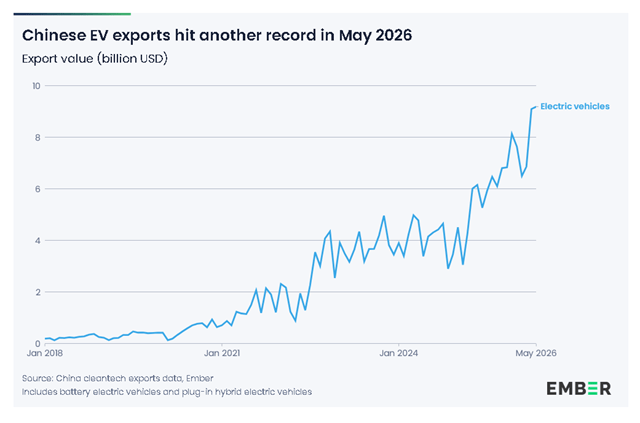
Backward-thinking strategies fail, i.e., another U.S. war of choice in the Middle East produces deep costs and consequences
A U.S. president attacking clean energy across the U.S. economy, e.g., stomping on EVs, delivers serious, multiple consequences
e.g. The American E.V. Has Been Crushed. Will It Take the U.S. Auto Industry With It?
The largest U.S. automakers have backed away from electric vehicles, even as global sales are booming. The decision may make them obsolete.
“The market” across the world responds…
“The disruption to global fuel markets caused by the Middle East conflict and the resulting impacts on fuel prices have accelerated transport electrification across ASEAN.”
“The current energy crisis has reinforced the value of electrification as a pathway to greater energy security, reduced fuel import exposure, and long-term transport cost savings.” — Ember